Are Calligraphy Letters Hard to Learn for Beginners?
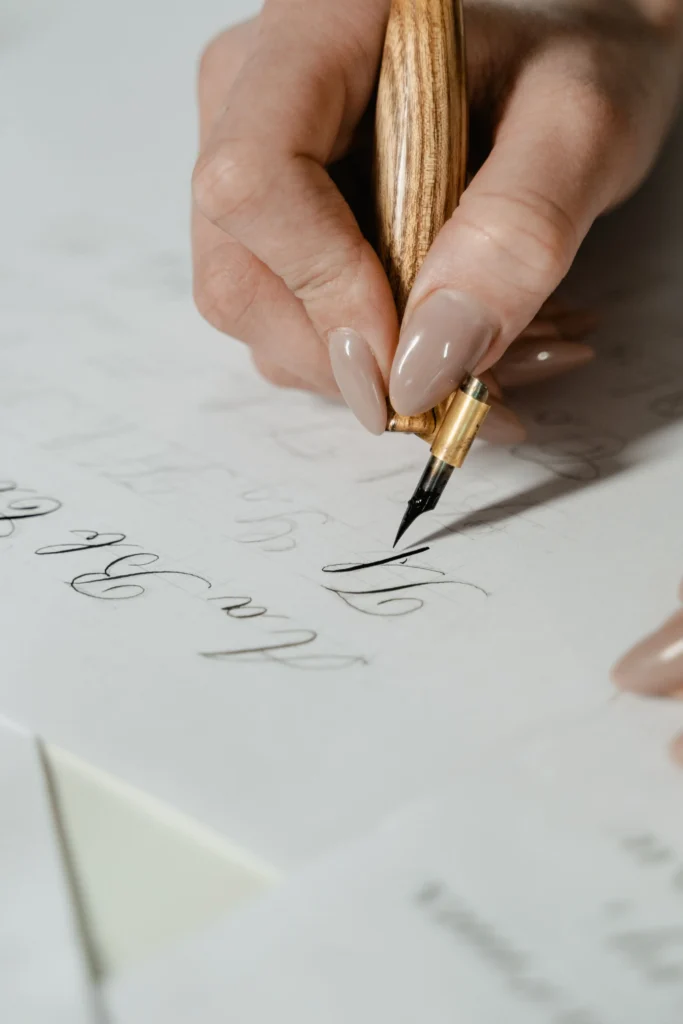
The letters of Calligraphy may seem to be difficult to learn at first but are actually not very complicated to master. After a few weeks of well-structured training with the right tools one can produce great and beautiful letters. The letters of Calligraphy are not art in the classical sense and therefore do not need to be artistic. The main problem of a beginner is the getting of the same movements into his muscles by repetition, in other words the building up of his memory. Once the single strokes and the white spaces between letter and letter have been mastered soon great progress is made. Patience and repetition are the most important things in Calligraphy. Every letter is perfect as soon as it has been written.
What Makes Calligraphy Letters Challenging for Beginners?
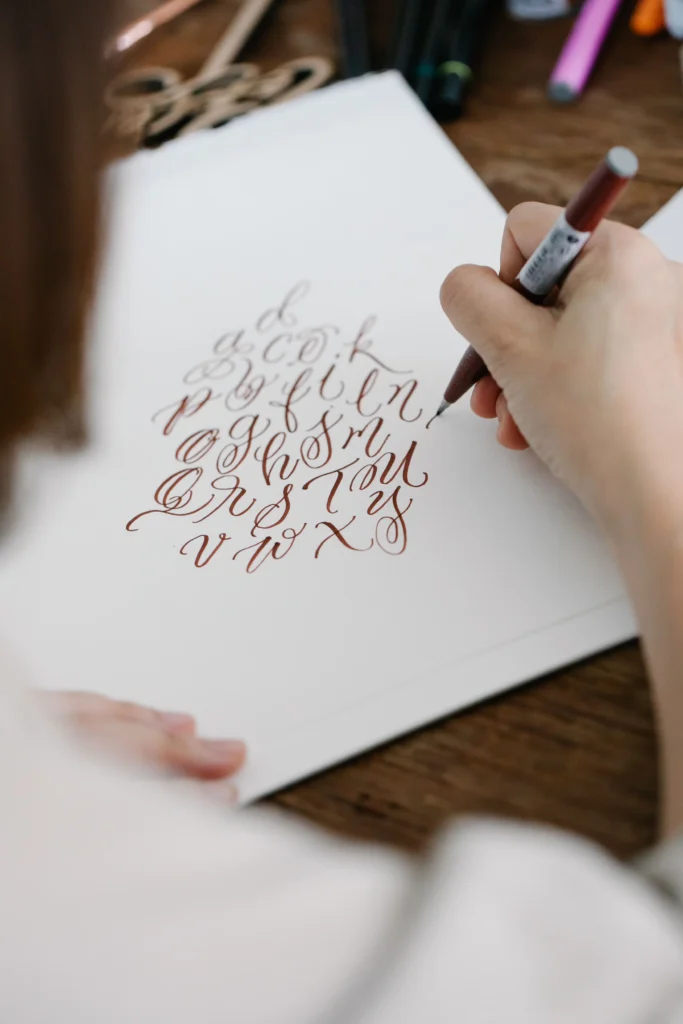
Writing in calligraphy requires three elements to create letters: rhythm, control of amount of pressure on pen or brush, and the letterform’s structure. For people who are new to writing in calligraphy many of their first letters and words look very ugly and often resemble drawing instead of typical writing. Here is a look at what can make calligraphy letters seem so difficult for people when they first start practicing writing with them.
Precision and Consistency in Letter Formation
When working with calligraphy it is very important to keep the space between the letters constant and the thickness of the lines even. Every stroke has to be done in a very specific way – in a certain direction and with a certain amount of pressure. Even the smallest imperfection, like an uneven slant to the letters or irregular loops in the letters, can affect the whole word. This is why for beginners it is best to start with the simple alphabets in Italic or Foundational Hand style, and then proceed to more complex and decorative alphabets like Copperplate or Gothic.
Control of Pen Pressure and Angle
One major technical challenge associated with working with ink is controlling the amount of pressure that is applied to the paper with the pen. Pens with broad edge nibs require the tines to be at nearly perfect angles in order to form a very wide line, while pens with pointed nibs produce thicker and thinner lines based on the amount of pressure that is applied to the paper. Many beginning lettering writers experience difficulty in their early work with ink because they naturally press too hard on the paper, or move the pen at uneven angles during lettering. The resulting blotches of ink and uneven strokes can make the letters appear to be messy and amateur. By first practicing drills such as ovals and parallel lines before attempting to write out letters, writers can build up the necessary amount of control and grow into writing with ink more smoothly.
Understanding Stroke Order and Flow
Each calligraphic style follows a specific stroke order. Deviating from the correct stroke order can lead to unappealing letterforms, disrupting the rhythm of your writing. For example, Copperplate script, a fluid traditional calligraphy style, relies heavily on transitioning between upstrokes and downstrokes smoothly. As such, it is imperative to write within the confines of the correct stroke order to achieve natural-looking lettering as opposed to stiff, unnatural looking letters.
How Can Beginners Start Learning Calligraphy Letters?
Firstly using the correct materials and studying methods to learn Chinese significantly facilitates the learning process. Programmed practice using a clear objective for each practice session can rapidly reverse learning frustration.
Choosing Suitable Tools for Practice
For beginners, it is wise to invest in good quality writing tools, smooth writing paper and ink and nibs/brush pens suitable for beginners. Modern brush pens are a good option as they eliminate the problem of ink flow whilst allowing the writer to practice using different levels of pressure. The surface texture of the paper is also important as some surfaces can cause the ink to snag and others cause the ink not to penetrate. Glossy surfaces are particularly bad for this.
Practicing Basic Strokes Before Full Letters
Before starting to write full alphabets, learners should first master simple strokes, for example upstrokes and downstrokes as well as curves and ovals. Practicing these so-called basic strokes with drills will lead to automatic movement instead of forced lettering. The basic strokes are the foundation of every letter.
Following Guided Worksheets or Online Courses
There is structured guidance on how to practice available to everyone and then there is guidance that professionals use to progress quickly in a very short space of time. Many professional calligraphers publish printable worksheets for letters, which can be printed out and used to practice, and these are broken down into the individual strokes for each letter. They also publish video tutorials online of how they form letters, which allows students to see their hand movements. This is far better than trying to follow static diagrams or written-out instructions.
What Are the Best Techniques for Improving Calligraphy Skills?
Consistent practice, coupled with reflection of one’s work, is fundamental to improvement. Even established artists and artists within particular mediums revisit some of the basic and fundamental exercises within their practice.
Repetition Through Daily Drills
Short daily practice sessions are more effective than long sessions practiced every now and then. By repeating the same strokes in short practice sessions you develop a rhythm and are able to shift more smoothly between your strokes. Keeping a dated practice log is very effective to keep track of your development. For a beginning player the practice log is a great motivator, because after a while the beginner feels that he/she is not improving anymore. The practice log will show the beginning player that he/she is improving.
Studying Exemplars from Master Calligraphers
Studying historical exemplars also reveals the proportion and space standards that are so often missing in modern tutorials. When looking at the way the masters handle line weight and/or curve tension, one learns to recognize balance – and that in itself is a big step in refinement.
Recording Progress Through Practice Sheets
Keeping track of organized practice sheets allows you to compare your early attempts to your later work. It is a great way to monitor your learning as it provides clear evidence of progress that may otherwise go un-noticed in your everyday work.
Which Styles of Calligraphy Are Easiest for Beginners?
Not all of the calligraphic scripts that are used today are easily approachable by everyone. While some scripts can be written with great freedom using a variety of tools, others demand very subtle control of the pen and even strict geometric accuracy. This can quickly become discouraging for beginners.
Modern Brush Script
Unlike traditional lettering using a brush and nib, modern brush lettering is very flexible and can be very forgiving in many situations, given the focus on creativity and expression versus trying to maintain uniformity. Since it utilizes a brush pen instead of a nib, there is much more control over the strokes and the natural transitions between varying widths of lines and such. There is also less to worry about with the ink flow, etc.
Italic Hand
Italic is one of the most common traditional calligraphy scripts that beginners learn, due to its gentle slant and clear form. It combines being visually beautiful with being very readable, making it perfect to learn for practice sheets as well as to use in real life, such as for creating invitations or for making signs.
Foundational Hand
The Foundational Hand was created by Edward Johnston at the beginning of the 20th century. The script is based upon simple circular forms which follow and are developed from a set of simple basic shapes. This clear and easy-to-read script can be an excellent warm-up before switching to more complicated scripts like Gothic or Spencerian script, because of the constant and clear rhythm between the individual letters.
How Long Does It Take to Become Proficient in Calligraphy Letters?
The amount of time it takes to reach intermediate proficiency in speechproduction varies with the amount of time that one can put into practice, but for the average student, this can happen in 3 to 6 months of regular practice.
The Role of Consistent Practice Frequency
Even practicing for 20 minutes every day can lead to improvements within weeks. However, practicing irregularly hampers progress because fine motor skills rapidly decline if not regularly reinforced.
Importance of Feedback from Experienced Artists
Constructive critique dramatically shortens the learning curve of drawing fundamentals. The best places to find critique are local drawing workshops and online communities of artists.
Realistic Expectations for Skill Development
Mastery of lettering takes years to achieve, but gaining fluency can happen a lot sooner than you think. In just a few months of regular practice, a beginner can become proficient enough to create high quality lettering for personal projects and small freelance jobs.
Why Do Some Learners Struggle More Than Others?
Each person has different amounts of patience, attention to detail and fine motor ability, but this in no way will impede progress with correct technique.
Physical Factors Like Hand Stability
If you have trouble with precise work due to unsteady hands, you might be frustrated at first, but as you begin to do your warm-ups your dexterity will improve as your wrist flexibility and your grip strengthen.
Psychological Barriers Such as Perfectionism
Many learners quit early due to unrealistic expectations of immediate perfection. Treating mistakes as data rather than failures encourages steady improvement without burnout.
Lack of Structured Learning Pathways
Students who learn Kung Fu by themselves, often, skip basic exercises that look trivial and boring. These trivial and boring exercises are foundational to learning Kung Fu and help to establish vital coordination that is required for more complex Kung Fu forms later on.
FAQ
Q1: Is calligraphy easier with a brush pen or dip pen?
A: Brush pens are easier to use than brushes written with dip pens. For one, they require less set up than a brush written with a dip pen. Also, with a brush pen, you have better control over the ink flow to your tip as you would re-ink a dip pen frequently.
Q2: How much time should beginners spend practicing daily?
A: 20 to 30 minutes per day of focused work should be enough to make progress without suffering from fatigue, consistent work is more important than the duration of the work session.
Q3: Can left-handed people learn calligraphy effectively?
A: Generally, yes. There may need to be some experimentation with paper angle or with specific nibs, but many professional calligraphers are left-handed.
Q4: What’s the best paper type for beginners?
A. Smooth bleed-proof paper for use with fine tip markers and or fountain pens that prevents feathering of ink while maintaining crisp edged lines.
Q5: When should a learner move from basic drills to full words?
A: Once basic strokes feel natural—typically after two weeks of daily drills—it’s appropriate to begin connecting them into simple words like “hello” or “love.”