Pen refills guide for size, ink type, and compatibility
Start with fit before ink preference
Pen refills are not universal. A replacement has to match the pen body, the writing mechanism, and the work the pen is expected to do. If the old refill is still available, use it as the reference: measure its total length, barrel diameter, tip shape, shoulder or collar position, and rear plug. If the old refill is missing, identify the pen type first. Slim multi-pens often use D1 refills, many full-size twist or click ballpoints use Parker-style G2 refills, capped rollerballs often use Euro-style rollerball refills, and many gel pens use brand-specific plastic cartridges. Ink feel matters, but physical fit determines whether the pen clicks, retracts, caps, and writes correctly.
For that reason, a good refill purchase starts with compatibility, not color or tip size. A refill can contain the right ink and still fail if it is a millimeter too long, too wide at the shoulder, or shaped incorrectly at the nose. When buying online, the safest approach is to search by the printed code on the old refill, then confirm the format and measurements before choosing ink color, point size, and writing style.

Common pen refill families and what they mean
Many refills look similar at first glance, but a few format families appear again and again in everyday pens. The names can be confusing because some are standards, some are brand names, and some are shorthand used by retailers and pen communities. The table below gives a practical comparison, not a guarantee of universal interchangeability.
| Refill family | Typical physical clue | Common use | Compatibility warning |
|---|---|---|---|
| Parker-style G2 or ISO G2 | Short refill, often around 98 mm, with a stepped front section | Many twist ballpoints, click ballpoints, and machined pens | Not the same as a Pilot G2 gel refill, despite the shared G2 name |
| D1 mini refill | Slim metal tube, often around 67 mm | Multi-pens, compact pens, small twist pens, stylus pens | Tip protrusion, rear plug shape, and spring position can still vary |
| Euro-style rollerball | Long refill, commonly near 110 mm, with a rollerball-style tip | Capped rollerball pens and some premium rollerball bodies | Usually not suitable for an uncapped retractable pen unless the maker specifies it |
| Pilot G2-style gel | Long plastic gel cartridge with a wider ink reservoir | Popular gel pens and some pens designed around that format | Different from Parker-style G2; do not buy by the word G2 alone |
| Proprietary refill | Unusual collar, threaded part, special rear end, or brand-specific shape | Some slim, luxury, promotional, and technical pens | May require the exact brand refill or a known adapter |
The main point is simple: refill names are useful clues, not final proof. Even within a common family, tolerances, springs, rear caps, and tip lengths can affect fit. When there is any doubt, compare photos, measurements, and the original refill code instead of relying on a broad phrase such as standard refill.
Ink type changes the writing experience
Once the refill format is correct, ink type becomes the next decision. Ballpoint ink is usually oil-based and controlled. It suits forms, notebooks, pockets, and everyday office use because it is less likely to feather heavily on ordinary paper. Traditional ballpoint refills can feel firmer or lighter than gel or rollerball options, although modern low-viscosity ballpoint inks are designed to write more smoothly.
Gel refills use a gel ink system that often produces darker, more vivid lines with less pressure. They are popular for note-taking, journaling, color coding, and users who prefer a smoother feel. The trade-off is that gel ink can run out faster than a comparable ballpoint refill, and drying time depends on paper, ink formula, and line width. Left-handed writers may prefer faster-drying gel options or finer tips to reduce smearing.
Rollerball refills use more fluid ink and can feel very smooth, almost like a fountain pen, without requiring a nib. They can deliver rich lines, but they also need more care. Some rollerball refills are designed for capped pens because the cap helps reduce drying at the tip. On thin paper, rollerball ink may show through or bleed more than a ballpoint line.
Hybrid ballpoint refills sit between classic ballpoint and gel behavior. They use lower-viscosity ink to reduce drag while keeping some of the control associated with ballpoints. For many daily users, a hybrid refill in a common format is a practical upgrade when the original ballpoint feels too dry or stiff.
How to identify a refill before buying
If you still have the empty refill, do not throw it away until the replacement has been tested. Printed codes, brand names, color markings, and small shape details are useful. A ruler can help, but calipers are better if you have them because refill compatibility is often decided in millimeters.
- Measure the total length. Include the rear cap or plastic plug if it is part of the refill.
- Measure the widest barrel diameter. A refill that is too wide can jam inside the pen body.
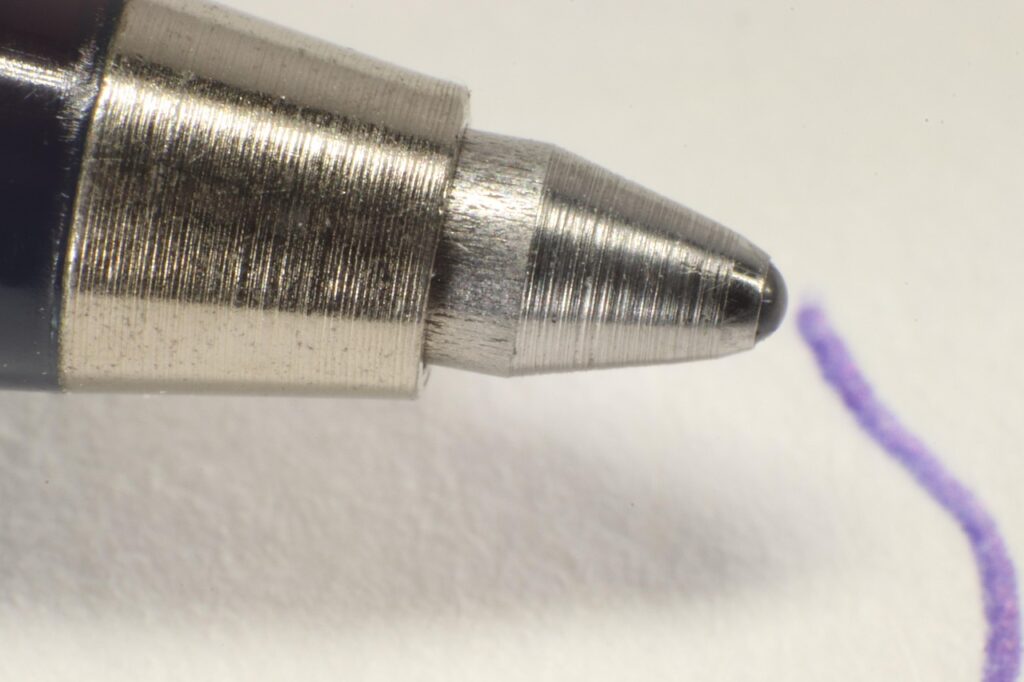
- Check the nose shape. The cone, needle tip, and shoulder determine how far the writing point extends.
- Look for a spring stop. Many retractable pens need the spring to sit against a specific collar or flare.
- Note the rear end. Some refills use a removable cap, a flat plastic plug, a crimped tube, or a threaded part.
- Photograph the refill beside a ruler. This helps when comparing listings that use similar-looking refill names.
If the old refill is missing, start with the pen body. A capped pen usually has different refill requirements from a click pen because the tip must seal differently. A twist ballpoint may accept a common refill family, but the twist mechanism still needs the correct rear length. A multi-pen often uses short, slim refills with color-coded ends. If the pen has a model name printed on the clip, barrel, or box, search for the exact model before searching by appearance.
Document use and refill standards
For ordinary school notes or desk writing, comfort and fit are usually enough. For legal forms, business records, laboratory notebooks, checks, archives, and official documents, the refill needs a stronger claim than simply black ink or blue ink. International standards separate general-use requirements from documentary-use requirements. ISO 12757 covers ballpoint pens and refills, ISO 14145 covers rollerball pens and refills, and ISO 27668 covers gel ink ball pens and refills. In these families, the part identified for documentary use is the part to look for when permanence matters.
This does not mean every refill from a familiar brand is automatically suitable for records. Compliance can differ by ink color, product line, and market. If documentary performance is required by an employer, school, government office, or archive, check the packaging or manufacturer data sheet for the exact standard and color. When the requirement is unclear, a conservative ballpoint refill with a documented documentary-use claim is often easier to verify than a decorative gel or specialty color.
Refillable pens and smarter purchasing
Refill choice also affects how long a pen body remains useful. A comfortable barrel with a common refill format can stay in service for years, while an attractive pen with a hard-to-find proprietary refill may become difficult to maintain. If you are choosing new pens for work, school, gifts, or retail planning, refill availability should be part of the decision alongside design, price, and writing feel. See also: Gift Guide.
From a purchasing point of view, standardized refills make inventory easier. An office might stock one reliable Parker-style G2 refill for full-size ballpoints, one D1 option for multi-pens, and one gel or rollerball refill for users who need a smoother line. Schools and studios may need more color variety, but the same principle applies: fewer refill formats reduce confusion and make it more likely that pens are reused instead of discarded.
There is also a waste angle. The U.S. EPA waste hierarchy places source reduction and reuse ahead of recycling, and a refillable pen supports that idea when the body is durable and the refill is actually replaced. The benefit is practical rather than automatic. If replacement refills are expensive, unavailable, or incompatible, users may still abandon the pen. A refillable system works best when the refill is easy to identify, easy to buy, and suited to the writing task.
Troubleshooting common refill problems
A new refill that does not work is not always defective. In many cases, the issue is format mismatch, storage, or installation. The following checks solve many everyday problems.
| Problem | Likely cause | What to check |
|---|---|---|
| Tip does not extend far enough | Refill is too short, spring is missing, or shoulder position is wrong | Compare total length and spring stop with the old refill |
| Tip stays out when retracted | Refill is too long or rear plug is wrong | Check rear cap length and mechanism clearance |
| Pen skips at first | Protective wax remains, ink is cold, or the refill is old | Remove any tip seal and test on ordinary paper |
| Ink smears | Ink dries slowly for the paper or hand position | Try a finer point, faster-drying formula, or more absorbent paper |
| Rollerball dries out | Refill is used in a poorly sealed or uncapped body | Use the refill only in a compatible capped pen |
| Click mechanism jams | Tube diameter, collar, or spring placement is incompatible | Do not force the mechanism; compare the refill shape again |
Some users trim plastic gel refills or add small spacers to make a near-fit work. That can be useful for hobby projects, but it is not the best first step for everyday users. Cutting a refill can cause leaks, weaken the rear seal, or make the refill unreliable. For a pen carried in a bag, pocket, or office drawer, choosing the correct refill is safer than modifying the wrong one.
Frequently asked questions
Are pen refills universal?
No. Some formats are widely used, but pen refills are not universal. Length, diameter, tip shape, spring position, and rear-end design all matter. A refill family name helps narrow the search, but the old refill or manufacturer compatibility list is more reliable.
Is Parker-style G2 the same as Pilot G2?
No. Parker-style G2 usually refers to a shorter refill format used in many ballpoint and machined pens. Pilot G2 refers to a popular gel pen and its longer gel refill style. Always check the full description when a listing says G2.
Can I put a gel refill in a ballpoint pen?
Sometimes. The gel refill must match the same physical format required by the pen body. For example, some Parker-style gel refills can replace Parker-style ballpoint refills in compatible pens. A random gel refill will not fit simply because the pen originally used ballpoint ink.
Which refill should I use for official documents?
Use a refill with a documented documentary-use claim that matches the type of pen and ink. Look for standards such as ISO 12757-2 for ballpoint, ISO 14145-2 for rollerball, or ISO 27668-2 for gel ink, and confirm the specific ink color if the document requirement is strict.
Should I choose fine, medium, or broad point?
Choose fine points for small handwriting, forms, planners, and faster drying. Choose medium points for general notes and everyday writing. Choose broad points when you want a darker, smoother line and the paper can handle more ink. Tip size affects feel, but ink formula and paper also influence the final line width.