
Are Prompted Journals Better Than Blank Notebooks?

Journaling with prompts in a journal is used by professionals, educators and people in mental health and many more. Because they are guided by a prompted journal they reach more structured results then you would get by just using a blank notebook. A lot of people use journaling for self reflection, for setting and keeping track of goals and for recognizing their emotions. Experts in for example psychology, productivitiy, training and sports and also creative writers work with journaling as well. And just like with every other tool there is a debate about the value of it, however not about how it looks but rather about the effects on the cognition. From our experience working with many different journals with and without prompts we see that the prompts help to cut down on decision making for journaling and therefore leads to a more consistant use of the journal. This makes prompted journals more useful for people that want to work on themselves in a more directed way rather then expressing themselves freely.
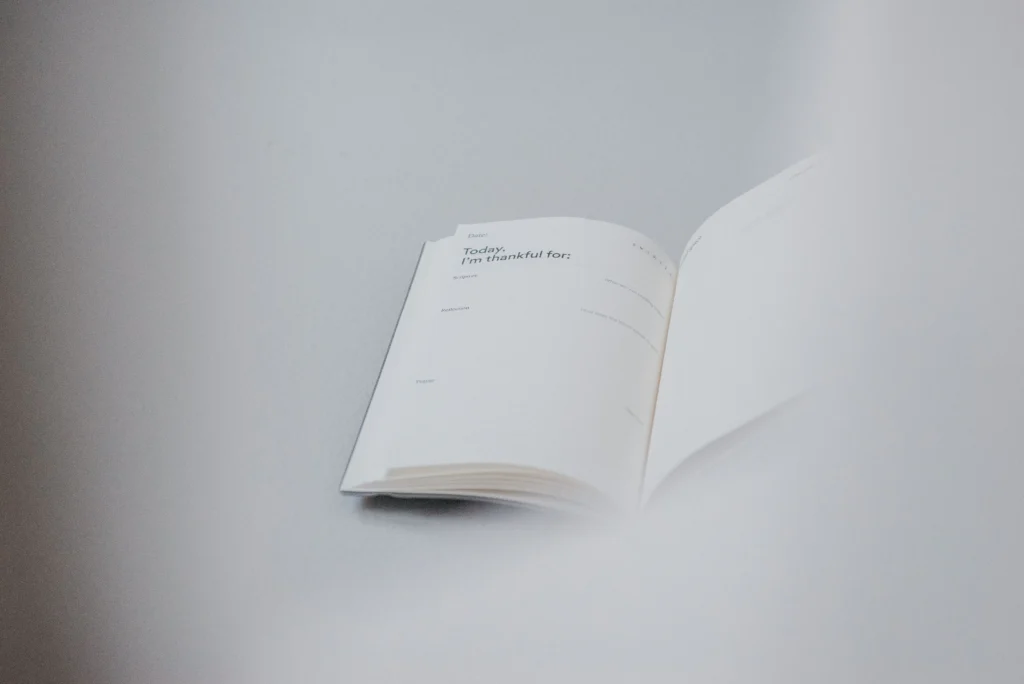
What Defines a Prompted Journal?
Journals that are prompted are different from normal notebooks as they have built in prompts that guide the writing of the user. These prompts can be as simple as a daily journal of things that the user is grateful for or a list of performance metrics that the user writes down on a regular basis.
Structured Writing Framework
A prompted journal provides predefined questions or statements to help users focus on specific topics. For instance, a productivity journal might include sections such as “Today’s top priorities” or “Lessons learned.” This structure supports consistency and reduces hesitation about what to write next.
Cognitive Engagement Through Prompts
Using prompts activates the pathways for reflective thinking. In studies of cognitive psychology guided writing in the form of writing prompts stimulates memory and emotions more than unguided writing because it is of limited scope.
Comparison With Free Writing
Blank notebooks are totally open and are therefore best used by people who have a lot of intrinsic motivation to fill them. Because of this they are often left untouched because users do not know where to start, are unsure how to continue once started or simply are overwhelmed by a completely blank page. Prompted notebooks offer structure in the form of guidance but also offer users complete freedom to express themselves as creatively as they desire.
How Do Prompted Journals Affect Mental Focus?
A common tool used by professionals for mental decluttering is journaling. The journaler’s chosen method, of prompted writing or blank pages, affects the efficiency with which thoughts are captured and processed in the written form.
Before we get into the subtopics, it’s worth noting that structured writing changes how you pay attention and what you’re trying to achieve. By setting up a good prompt sequence, you can turn journaling into a form of cognitive training instead of just throwing down random notes.
Reduction of Decision Fatigue
By limiting the choices that the user has when writing, they are freed from having to spend too much energy on minor aspects of the writing, and are able to engage in more depthful thought instead. This aligns with the findings of research in the field of behavioral economics on decision making, including studies that found that limiting the user’s exposure to small decisions would enable them to focus on more complex analytical tasks.
Enhanced Goal Orientation
Many prompted journals will include sections to track your progress throughout the time you use the journal. For example a fitness journal might include a prompt to fill in each day such as ‘What was your small win for today?’. Repeating these prompts day in and out to track your habits develops connections in the brain that assist with developing habits.
Emotional Regulation Benefits
Using emotion-centered prompts in your writings will enable you to label and process your feelings probably more than you would in spontaneous writings. For clients dealing with anxiety and burnout, therapists often suggest just writing about their experiences and then processing the resulting writings with the therapist.
Why Do Professionals Prefer Prompted Journals Over Blank Notebooks?
Whether in engineering, research, business or teaching, all experts in their respective fields like prompted formats much better than free-style texts since the latter just consist of many loose words whereas the former immediately allow to check and measure something.
We prefer these descriptions for several practical reasons: the time frame for the application, traceability of data, and the description of results. This applies for corporate coaching as well as clinical settings.
Consistency in Data Collection
Using prompted journals the psychologist will get fill out the same entries in the long run. A psychologist analyzing patient progress benefits from having fill out uniform entries in the form of questions and rate scales instead of writing free-form notes.
Time Efficiency
While professionals often don’t have time to dedicate to open-ended, unstructured writing, prompts will help jump start your writing engagement instantly as they negate the usual blank-page warm up time found in blank-page journaling.
Integration With Professional Tools
A number of the prompted journals mentioned in this post now sync with online platforms and / or analytics dashboards. This is a feature that many consultants will find very useful, as they can then track key performance metrics whilst also benefiting from the insights gained from their journal entries.
Can Prompted Journals Enhance Creativity Instead of Limiting It?
The widespread misconception that structure stifles creativity is, however, undermined by the growing body of research which shows that well-designed prompts are not a constraint on ideas but their catalyst.
When it comes to creatives — writers, designers, musicians — setting boundaries helps in their pursuit of innovative work. But then so do journaling frameworks that challenge one’s typical patterns of thought when posed a set of specifically queried questions in written form.
Prompts as Creative Constraints
Constraints to creative writing can even stimulate divergent thinking, for instance by forcing the reader of a text to come up with new connections between single ideas. Also a prompt like “Describe your day by means of metaphors” encourages linguistic experimentation in a way a completely blank page wouldn’t.
Habitual Pattern Disruption
By introducing a fresh slant or perspective on your daily routine, prompts stop you from creating repetitive stories. In the long run, such variation expands rather than contracts your creative fluency.
Reflection on Process Rather Than Product
While practicing prompted journaling one begins to focus on processes rather than attempt to write the perfect prose and that’s where an artist can really delve into refining their work from exploring surface aesthetics to increasing conceptual depth.
How Do Prompted Journals Support Long-Term Personal Development?
Continuing to write in a journal for several months is linked to sustained growth. Whether or not a journaling format continues to support someone over several months or years is determined by that initial format.
Going from short-term reflection to long-term transformation requires a structured follow-up of the progress checkpoints without becoming too complicated.
Habit Formation Mechanisms
The daily prompts for routine engagement function as behavioral cues or triggers that get people to behave in certain ways and thus form or reinforce habits. By triggering the same behavior at the same time and in similar environments repeatedly, such prompts replicate the structure of the classic habit-loop, where the same environmental cue triggers the same behavior over and over again.
Feedback Loops Through Review Sections
Many prompted journals have weekly or monthly review pages that help the user to recall achievements as well as setbacks enabling feedback for the adaptive learning cycles.
Alignment With Growth Frameworks
The structured formats of many learning journals incorporate methods such as the setting of SMART goals, or utilize models of cognitive-behavioral type for reflection. As a result, they can also be integrative with formal, professional coaching systems and their emphasis on measurable development.
Are There Situations Where Blank Notebooks Work Better?
While prompts are very useful, empty notebooks have their use in situations where more freedom than structure is needed, for example in exploratory research or when beginning an artistic brainstorming session.
There is no implication of superiority or inferiority here. Rather the distinction rests on the purpose that reading and studying and other uses of written language serve.
Unrestricted Concept Exploration
Early Researchers developing theoretical models such as researchers working on a theoretical model prefer a blank page to create a map of all non-linear relations. On a blank page researchers have space to create without prompt interference. A blank page allows for associative thinking between many different domains.
Therapeutic Free Expression
In trauma work, there is value in clients having the opportunity to freely express themselves in written form without first having gone through a cognitive process to organize their thoughts and emotions. This can be especially powerful when clients are able to externally express emotions that have been internally stuck for clients. Journaling can be done without the use of pre-set questions, allowing for a more freely expressed form of self-expression.
Artistic Flow States
For artists seeking immersion, uninterrupted creative flow is more important than the rigid structures of templates that could prevent spontaneity, and consequently, block guided introspection.
FAQ
Q1: What’s the difference between a prompted journal and a planner? A: A planner is used for planning and monitoring of tasks and activities. A prompted journal on the other hand is used for reflection by means of prompted questions.
Q2: Are digital prompted journals as effective as physical ones? A: Effectiveness depends on user preference. The digital version of a prompted journal offers the user advantages of using digital media and the option of adding analysis functions. On the other hand, physical prompted journals foster tactile media usage, which in turn can have a positive effect on memory.
Q3: Can blank notebooks be turned into prompted journals? A: Yes. Simply add in the odd number of questions that can be recurring that help to keep you on track to your goals and in the thematic sections that help you to meet your personal objectives. This gives you lots of flexibility and yet the guidance that you need in a journal.
Q4: Do prompted journals improve mental health outcomes? A: Yes. From clinical studies prompted journals increase level of stress reduction and emotional awareness over simply writing self-reflective journals.
Q5: Which type of journaling is best for professional development? A: For the goal-oriented businessperson, prompted journals are far more effective than blank notebooks for monitoring progress and tracking their improvement in alignment with their performance goals.